
By Manu Rao | Updated March 2026
At a Glance
| Indian Diaspora | 15,000-16,000 |
| FDI Route | Automatic route for most sectors |
| DTAA | 10% dividend withholding |
| Document Authentication | Apostille (Hague Convention member) |
| Realistic Timeline | 6-8 Weeks |
| Currency | RUB |
Why Russian Investors Are Looking at India
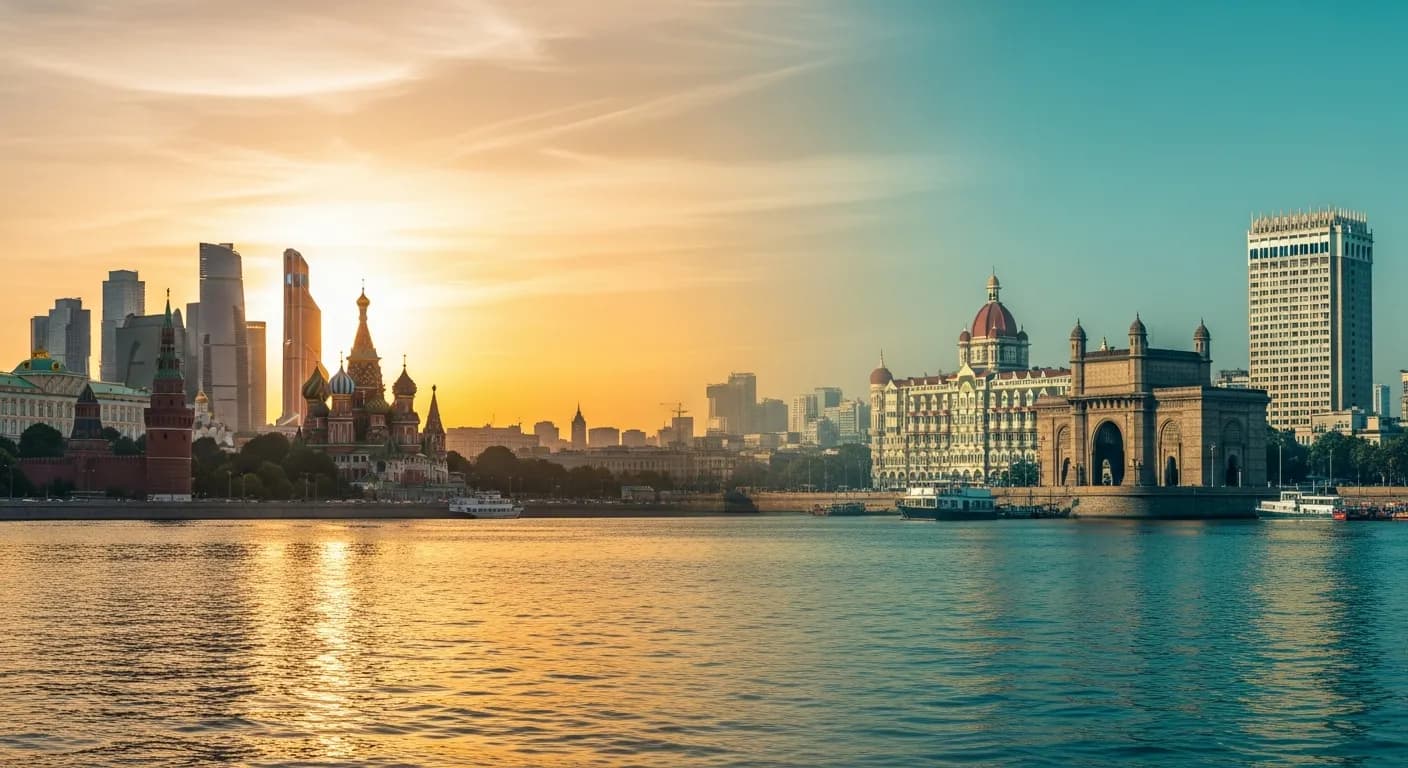
The trade numbers tell the story. India-Russia bilateral trade crossed $70.6 billion in calendar year 2024 — a record. That is 5.8 times the pre-pandemic figure of $10.1 billion. For FY 2024-25, the number stands at $68.7 billion per Indian government data.
Energy drives this relationship. India imports over $63 billion worth of crude oil and petroleum products from Russia annually. But the story goes beyond oil.
Rosneft's $20 billion acquisition of Essar Oil (now Nayara Energy) remains the single largest Russian investment in India. BrahMos Aerospace, the India-Russia joint venture, produces supersonic missiles that are now exported to other countries. Rosatom is building six new nuclear power units at Kudankulam in Tamil Nadu. These are not small bets.
Both governments have set a target of $100 billion in bilateral trade by 2030. In July 2024, PM Modi visited Moscow and both sides agreed to fast-track the Program of Economic Cooperation 2030. Six new strategic projects in advanced manufacturing, digital infrastructure, and innovation were approved in April 2025.
Russia and India now settle over 90% of bilateral trade in rupees and rubles, bypassing the US dollar entirely. The RBI's Vostro account framework, launched in July 2022, made this possible. If you are a Russian business looking to enter the Indian market, the financial plumbing is already in place.
Choose Your Entity Type
Pick the right structure before you file a single form. This choice shapes your tax treatment, compliance load, and ability to raise capital down the road.
| Feature | Private Limited Company | LLP | Branch Office | Liaison Office |
|---|---|---|---|---|
| FDI Route | Automatic (most sectors) | Automatic (some sectors) | RBI approval | RBI approval |
| Minimum Directors/Partners | 2 directors, 1 must be Indian resident | 2 partners, 1 must be Indian resident | Authorized representative | Authorized representative |
| Residency Rule | Director: 182+ days in India during the financial year | Partner: 182+ days in India during the financial year | N/A | N/A |
| Annual Audit | Yes, mandatory | If turnover exceeds Rs 40 lakh or contribution exceeds Rs 25 lakh | Yes | Yes |
| Compliance Load | High (board meetings, AGM, multiple annual filings) | Moderate | Moderate | Low |
| Can Raise External Equity | Yes | No | No | No |
For most Russian investors, a Private Limited Company is the recommended choice. It allows equity investment under the automatic FDI route, gives you a separate legal entity in India, and creates a clean structure for profit repatriation.
A Liaison Office works if your goal is market research or brand promotion without actual trading activity. Branch Offices need RBI approval and work for companies that want to extend their Russian operations into India without creating a new entity.
LLPs suit professional services firms. But remember — LLPs receiving foreign investment face sector restrictions under DPIIT's Consolidated FDI Policy. An LLP is not just a simpler version of a Private Limited Company. They are different structures with different rules.
FDI Route and Sector Rules
India permits 100% FDI through the automatic route in most sectors. No government approval needed. IT services, manufacturing, healthcare, financial services, and e-commerce (marketplace model) all qualify.
Government approval is required for defence above 74%, media and broadcasting, multi-brand retail, and a few other sectors listed under DPIIT's Consolidated FDI Policy (updated via Press Notes periodically).
Prohibited sectors — off limits regardless of structure or nationality — include atomic energy, lottery, gambling and betting, chit funds, Nidhi companies, trading in transferable development rights, and real estate business (but construction development is allowed).
Press Note 3 of 2020 does NOT apply to Russian investors. That restriction, which requires government approval for FDI from countries sharing a land border with India, targets China, Pakistan, Bangladesh, Nepal, Bhutan, Myanmar, and Afghanistan. Russia is not on this list.
Where do Russian investors actually put their money? Per available data, the top sectors are energy and petroleum (Rosneft/Nayara Energy), defence equipment and joint ventures (BrahMos Aerospace), nuclear energy (Kudankulam via Rosatom), steel and metals, and banking (Sberbank has a branch in India). Russian FDI equity inflows tripled to $18.45 million in FY25 (April-December 2024), per DPIIT data.
Step-by-Step Registration Process
Choose Your Entity Type and State Decide between Private Limited, LLP, Branch, or Liaison Office. Pick your registration state. Maharashtra, Delhi, Karnataka, and Gujarat are common choices for Russian investors given the concentration of energy and industrial activity.
Obtain a Digital Signature Certificate (DSC) Every proposed director needs a Class 3 DSC. Foreign nationals require a passport copy and a video verification call with a certifying authority. Processing takes 1-3 days.
Apply for Director Identification Number (DIN) DIN is now bundled into the SPICe+ incorporation form. You do not file separately. MCA simplified this under the Companies (Incorporation) Rules, 2014 as amended.
Reserve Your Company Name Use MCA's RUN (Reserve Unique Name) service. Two name options per application. Approval takes 1-4 working days. MCA rejects names too similar to existing companies on their registry. Avoid generic or overly broad names.
Prepare and Notarize Documents You need the Memorandum of Association (MOA), Articles of Association (AOA), director declarations under Section 152 of the Companies Act 2013, and proof of registered office in India. Russian directors must get documents notarized through a Russian notary.
Apostille Your Documents Russia is a Hague Apostille Convention member (since 1992). India is also a member (since 2005). This means Russian documents can be apostilled — you do NOT need embassy attestation.
The apostille authority depends on your document type. For notarial documents and court judgments, submit to the territorial office of the Ministry of Justice. For educational documents, go through the Federal Service for Supervision in Education and Science (Rosobrnadzor). For civil records like birth and marriage certificates, use the territorial civil registry office (ZAGS).
Processing times vary. Educational documents can take up to 45 days. Notarial documents typically take 5-10 business days. Plan this step early — it is usually the longest part of the process.
Sanctions note: Due to Western sanctions on Russia (since 2022), some international courier and third-party document processing services may have limited availability. Budget extra time for document logistics.
Receive Certificate of Incorporation MCA issues the Certificate of Incorporation with PAN and TAN. Your company legally exists from this date. You need this certificate to open a bank account and begin operations.
Document Checklist and Authentication
- Passport copy (all pages, notarized by a Russian notary)
- Address proof (utility bill or bank statement, less than 2 months old, notarized)
- Passport-size photographs
- Bank reference letter or last 6 months bank statements
- Board resolution or authorization letter (if corporate shareholder)
- MOA and AOA (drafted and notarized)
- Director declarations (INC-9)
- Proof of registered office in India (lease agreement or utility bill)
All Russian documents must be apostilled through the appropriate Russian authority. Russia joined the Hague Convention in 1992. India accepts apostilled Russian documents without further embassy attestation.
India-Russia DTAA: Tax Rates at a Glance
The India-Russia Double Taxation Avoidance Agreement was signed on December 29, 1994, and has been in force since June 22, 1996. It replaced earlier arrangements with the USSR. The rates are straightforward.
| Income Type | Without DTAA | With India-Russia DTAA |
|---|---|---|
| Dividends | 20% | 10% |
| Interest | 20% | 10% |
| Royalties | 20% | 10% |
| Fees for Technical Services | 20% | 10% |
A flat 10% across the board. No tiered rates based on ownership percentage. No special carve-outs for banks or specific equipment types. This makes the India-Russia DTAA one of the simpler treaties in India's network.
Government institutions are exempt from tax on interest earned under the treaty.
Surcharge and health and education cess are not levied on top of treaty rates. Under domestic law, surcharge can push the effective tax rate above 20%. The treaty caps it at 10% flat.
To claim DTAA benefits, you need a Tax Residency Certificate (TRC) from the Russian tax authorities confirming your tax residence in Russia. Apply well in advance — processing can take several weeks.
One important gap: the bilateral investment treaty (BIT) between India and Russia expired in 2017. Negotiations for a new BIT started in July 2024 but no agreement is in place yet. This means Russian investments in India currently lack BIT protection against expropriation or unfair treatment. The trade relationship is strong, but the legal safety net has a hole in it.

Realistic Timeline: 6-8 Weeks, Not 7 Days
Other websites promise company registration in 7-15 days. That timeline assumes your documents are already apostilled, your DSC is ready, and MCA does not ask a single follow-up question. For Russian investors, that never happens.
Here is what actually takes time:
- DSC + DIN: 1-3 days
- Name reservation: 1-4 working days
- Document preparation and apostille in Russia: 2-6 weeks (the bottleneck — educational docs can take 45 days)
- SPICe+ filing to Certificate of Incorporation: 5-15 working days
- Bank account opening: 3-5 weeks (extra KYC for Russian-linked entities due to sanctions screening)
- GST registration: 1-3 weeks
Total realistic timeline: 8-12 weeks from start to operational. The apostille step and bank account opening are the two biggest delays. For Russian investors specifically, bank KYC takes longer than usual because Indian banks must run sanctions screening against OFAC, EU, and UK sanctions lists.
Post-Registration Compliance
Incorporation is just the beginning. Here is your annual compliance calendar:
- Within 30 days of share allotment: File FC-GPR (Foreign Currency Gross Provisional Return) with RBI through your Authorized Dealer bank. This is mandatory under FEMA. Miss it and you face penalties.
- Board meetings: Minimum 4 per year for Private Limited companies. Maximum gap of 120 days between consecutive meetings.
- AGM: Before September 30 each year.
- AOC-4: Financial statements filed within 30 days of AGM.
- MGT-7: Annual return filed within 60 days of AGM.
- Statutory audit: Mandatory every year. No exceptions for foreign-owned companies regardless of size.
- Income tax return: Due by October 31 for companies requiring audit (all foreign-owned companies do).
- GST returns: Monthly GSTR-3B and GSTR-1 if registered. Quarterly option available below Rs 5 crore turnover.
- Transfer pricing: If your Indian subsidiary transacts with the Russian parent, maintain transfer pricing documentation under Section 92D of the Income Tax Act. Indian tax authorities scrutinize cross-border related-party transactions closely.
Bank Account Opening: Expect Extra Scrutiny
Opening a current account for a foreign-owned Indian company normally takes 2-4 weeks. For Russian-owned entities, add another 1-2 weeks.
Indian banks run extra KYC checks on any company with Russian directors, shareholders, or beneficial owners. This is not because of Indian sanctions — India has not sanctioned Russia — but because Indian banks with international correspondent banking relationships must comply with OFAC and EU sanctions screening to maintain those relationships.
HDFC, ICICI, and Kotak tend to process foreign-owned company accounts faster than public sector banks. Even so, expect questions about the source of funds, beneficial ownership structure, and the nature of business.
You will need to make FATCA/CRS declarations. The Authorized Dealer bank will verify your FC-GPR filing status. At least one director may need to visit the bank branch in person.
The rupee-ruble settlement mechanism helps. Over 90% of India-Russia trade is now conducted through rupee Vostro accounts at Indian banks. Some banks are more experienced with Russian business relationships than others — ask specifically about their Russia desk or international banking team.
Profit Repatriation
Getting profits out of India is procedural, not difficult. The main channels are dividends, royalties, management fees, and share buyback.
For any outward remittance, follow this process: TDS deduction at source at DTAA rates (10% for dividends, interest, royalties, and FTS), issuance of Form 16A (TDS certificate), obtain a CA certificate in Form 15CB, file Form 15CA online on the Income Tax portal, and take these documents to your Authorized Dealer bank for the wire transfer.
The twist for Russian investors: traditional SWIFT-based transfers to Russia are disrupted due to Western sanctions. Repatriation typically happens through rupee-ruble settlement mechanisms. Discuss the specific transfer route with your AD bank before assuming a standard wire will work.
Under the DTAA, dividends are taxed at 10% (flat, no tiered rate). This is better than the domestic rate of 20% plus surcharge. Structure your profit extraction around this favorable treaty rate.
Exit Strategy
If things do not work out, you have two main paths.
Strike-off under Section 248 of the Companies Act, 2013: For dormant companies with no assets or liabilities. The company must not have conducted business for the preceding two financial years. Apply to the Registrar of Companies. A public notice is published, objections are invited for 30 days, and then the name is struck off.
Voluntary liquidation under Section 59 of the Insolvency and Bankruptcy Code, 2016: For active companies. Requires a special resolution, appointment of an insolvency professional as liquidator, and a structured wind-down. Typically takes 6-12 months.
Neither is quick. Budget 6-18 months for a complete exit depending on the complexity of your operations and whether any tax assessments are pending.
How Beacon Filing Helps
We handle the complete India entry process for investors based in Russian Federation. From initial structuring through post-incorporation compliance, here is what we cover:
- Foreign Direct Investment advisory — route selection, sector analysis, RBI compliance, and FC-GPR filing
- Resident Director services — appointment of a qualified Indian resident director who meets the 182-day requirement
- Company setup and incorporation — SPICe+ filing, DSC, DIN, name reservation, and Certificate of Incorporation
- Tax and DTAA advisory — treaty benefit structuring, transfer pricing documentation, and annual compliance
- Accounting and statutory audit — bookkeeping, financial statements, ROC filings, and GST returns
Related Country Guides
Setting up from a different country? These guides cover similar territory:
- Register a Company in India from Germany
- Register a Company in India from United Kingdom
- Register a Company in India from United States of America
Get in Touch
Setting up an Indian company from Russian Federation? Talk to us. No commitment, no generic sales pitch. We will walk you through the structure, timeline, and costs specific to your situation.
WhatsApp: +91 874 501 3644 | Email: [email protected]
Frequently Asked Questions
- Sanctions screening: Indian banks run extra KYC against OFAC, EU, and UK sanctions lists for Russian-linked entities. India itself has not sanctioned Russia, but banks must protect their international correspondent relationships.
- Rupee-Ruble settlement: Over 90% of bilateral trade settled in local currencies through RBI Vostro account framework (since July 2022). This is the primary fund transfer mechanism.
- No active BIT: The 1994 India-Russia BIT expired in 2017. New BIT under negotiation since July 2024. No treaty protection for investments as of March 2026.
- INSTC: International North-South Transport Corridor being operationalized — expected to reduce logistics costs by 56%.
- Hague Convention: Both Russia (1992) and India (2005) are members. Apostille route is valid for document authentication.
Indian Embassy / Consulates
Embassy of India, Moscow. Consulates in St. Petersburg and Vladivostok.
Explore More Country Guides
 Europe
Austria
India-Austria bilateral trade reached $2.98 billion in 2024. Over 150 Austrian companies already operate in India, from voestalpine steel to Andritz hydro. With a uniform 10% DTAA rate, the tax treaty is one of India's most favorable.
Read guide
 Europe
Belgium
Belgium and India traded $12.91 billion in FY 2024-25. The Antwerp-Surat diamond corridor has linked both economies for decades. With 37 new agreements signed in March 2025 and the India-EU FTA concluded, the relationship is accelerating.
Read guide
 Europe
Cyprus
Cyprus is the ninth-largest source of FDI into India with USD 15.76 billion cumulative investment, Cypriot shipping firms just committed INR 10,000 crore to Indian maritime, and the EU-India FTA concluded in January 2026 makes Cyprus the gateway between Europe and India. Here is how to register an Indian company from Cyprus.
Read guide
 Europe
Czech Republic
Bilateral trade between India and the Czech Republic has grown 37x since 1993, crossing $3 billion. With the 2024 Strategic Partnership on Innovation and the EU-India FTA now in place, the doors are wide open for Czech investors.
Read guide